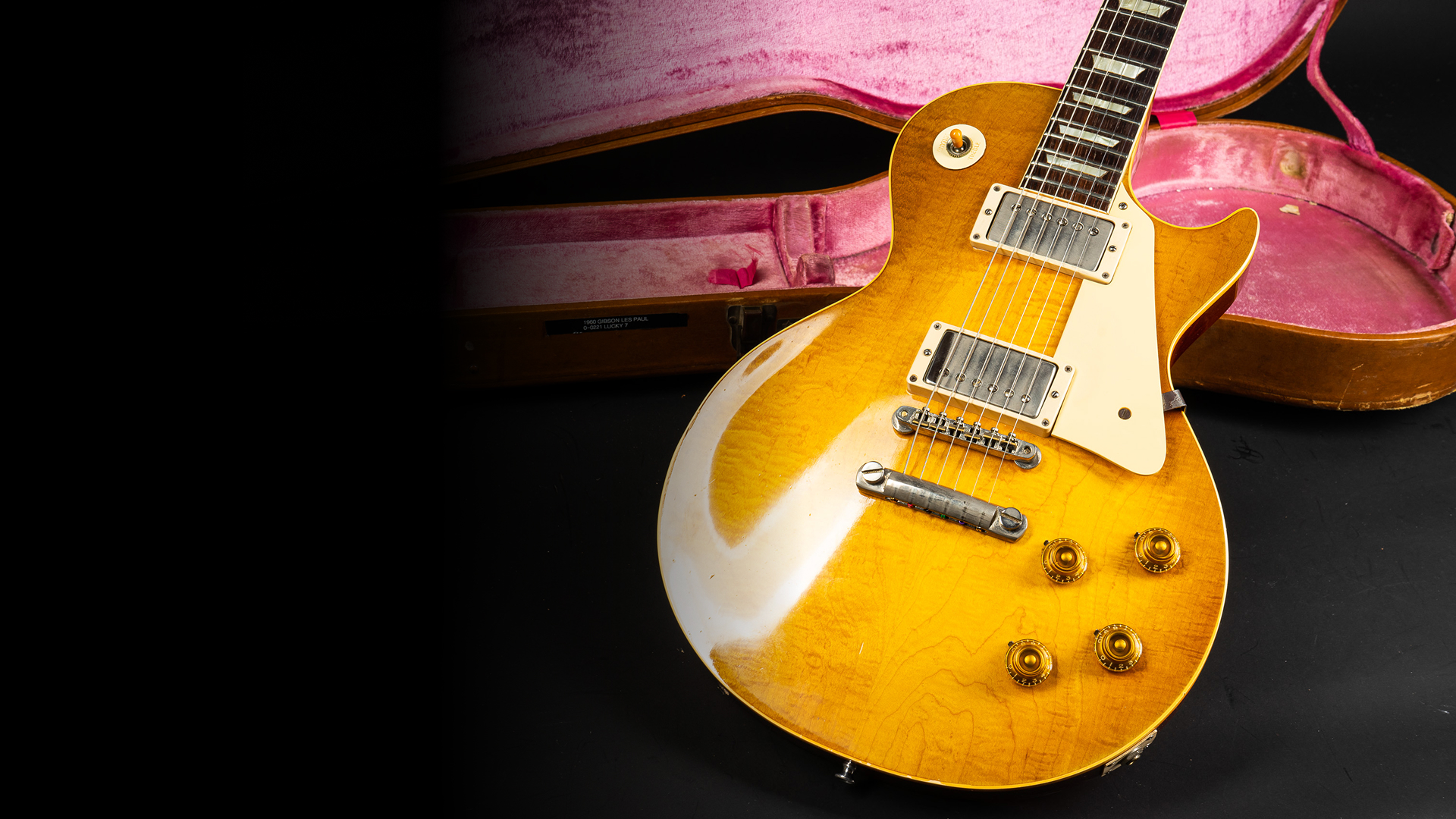
Discover the Magic
of True Vintage Guitars
Vintage or used? What is vintage and what is “just” old? There are certainly different approaches and definitions here. Some people claim that a new guitar will also be vintage in 50 years…well, that’s certainly not the case. That alone would contradict the definition of the word “vintage.”
For us, vintage electric guitars are classic instruments built between 1950 and 1965 – with an extension to 1975. We would like to explain why here.
The Golden Age
of Electric Guitars
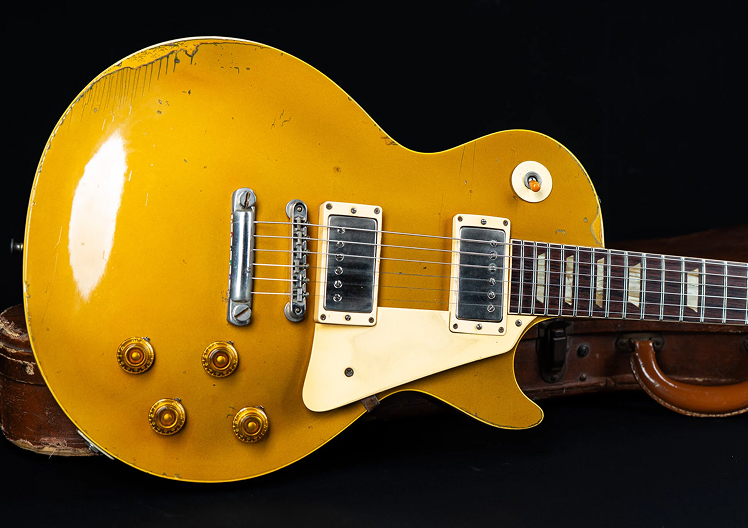
Vintage guitars are old, rare, and often valuable instruments with historical and collector value. The question is certainly not when an electric guitar is considered “vintage,” but rather until when. The Golden Age of Electric Guitars spans from the first Fender Esquire in 1950 and the first Gibson Les Paul Model in 1952 to the first major cutbacks at both companies in 1965.
When Quality
Meets Efficiency
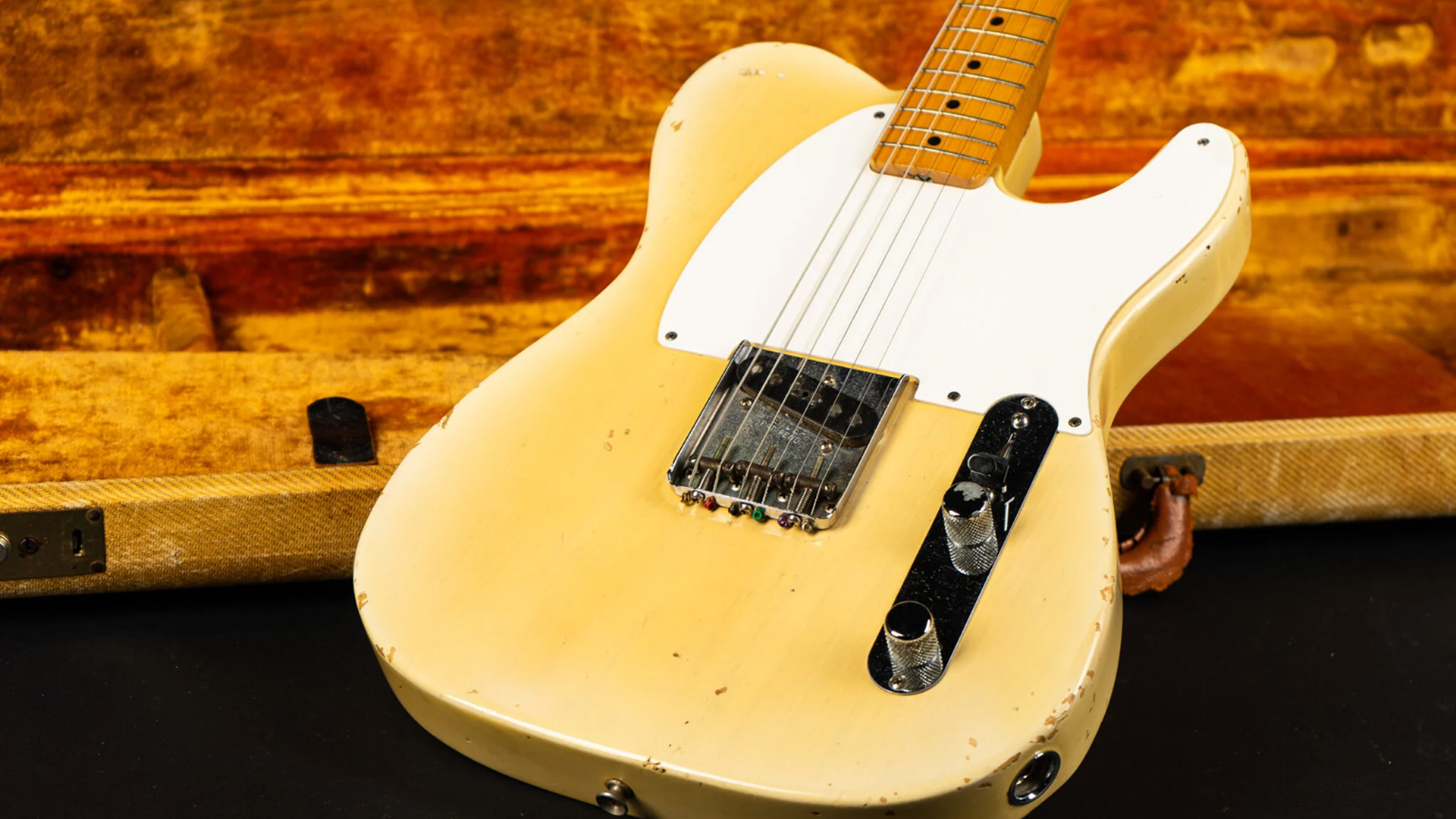
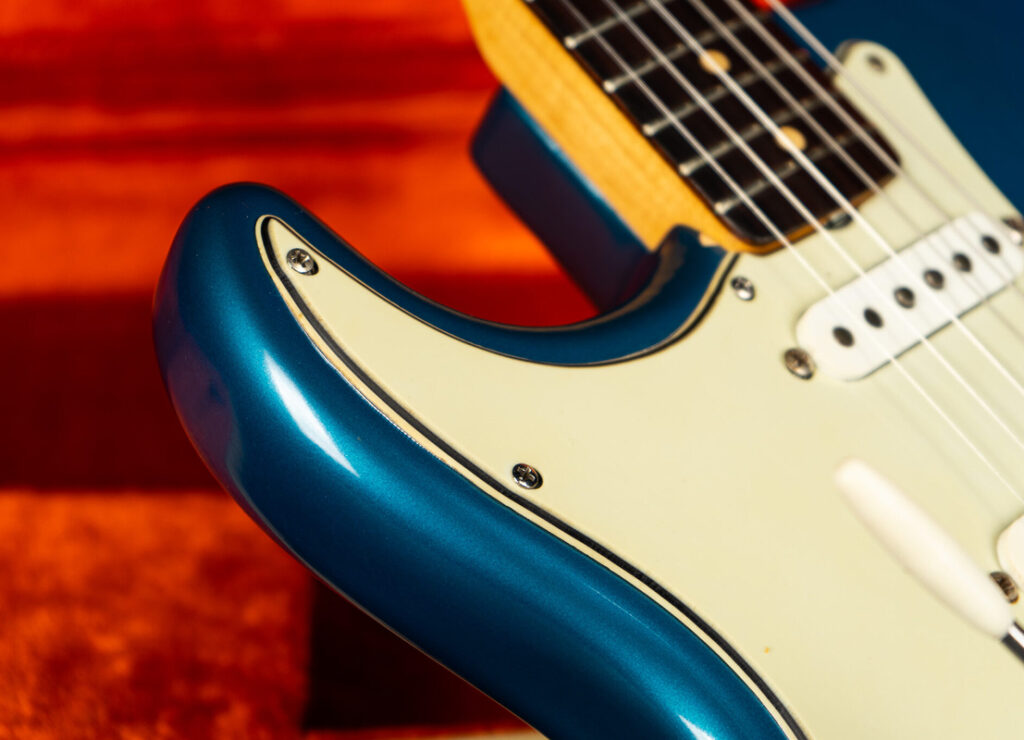
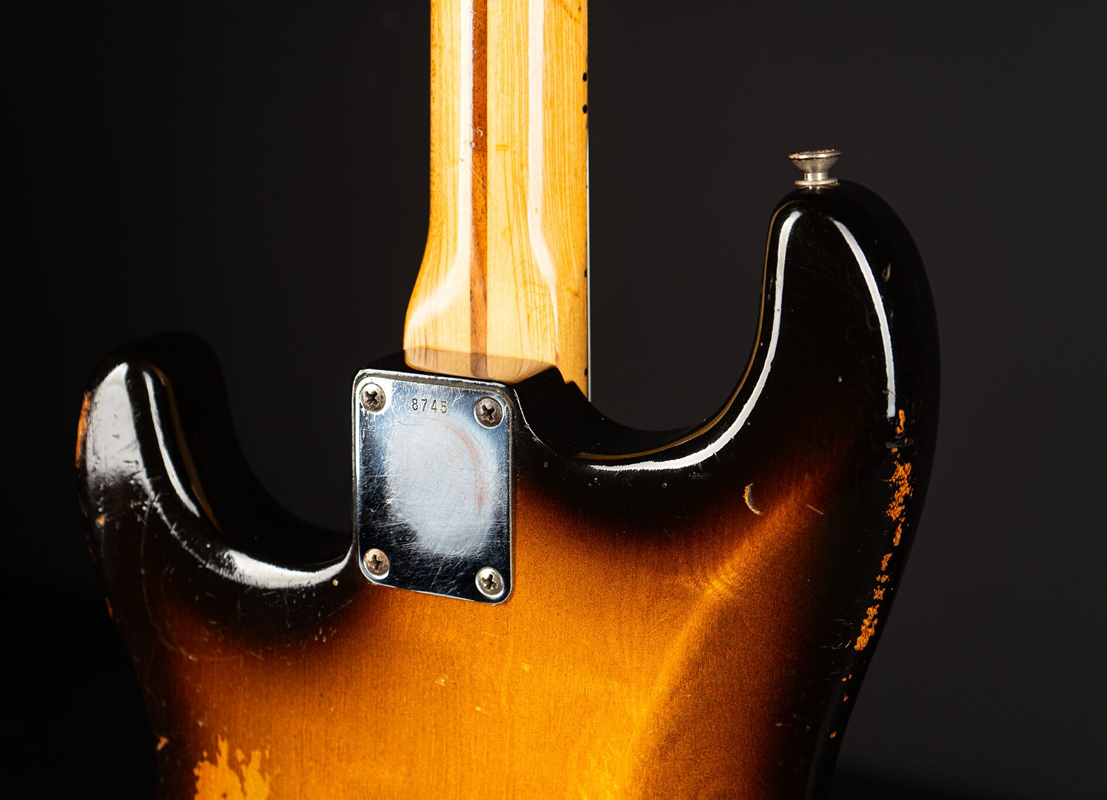
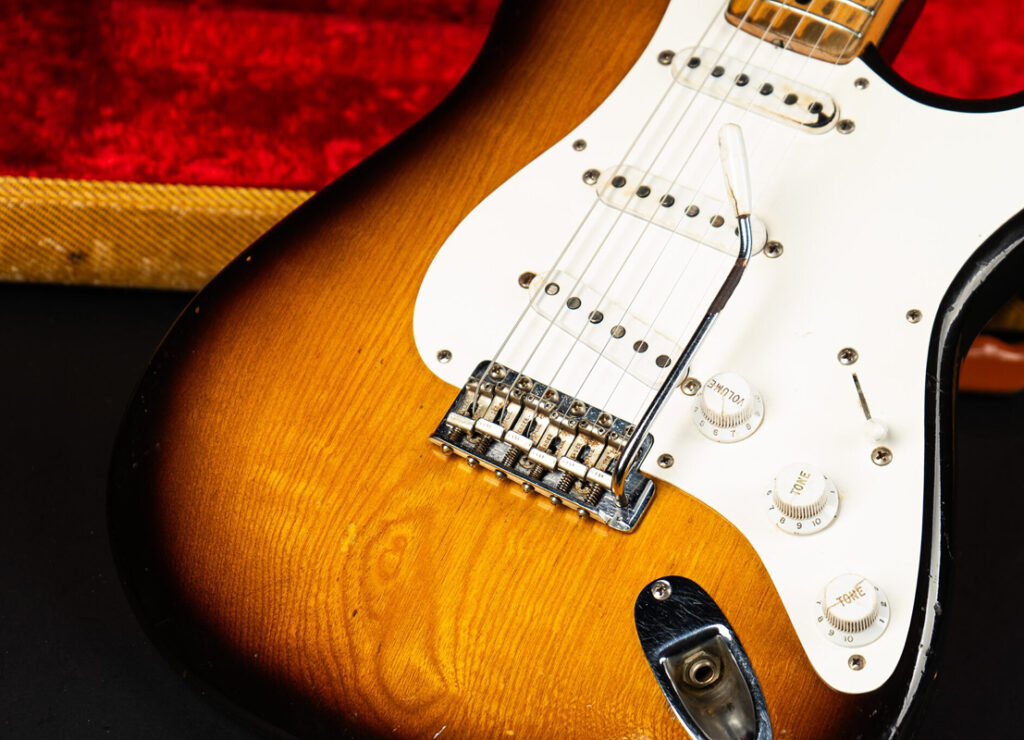
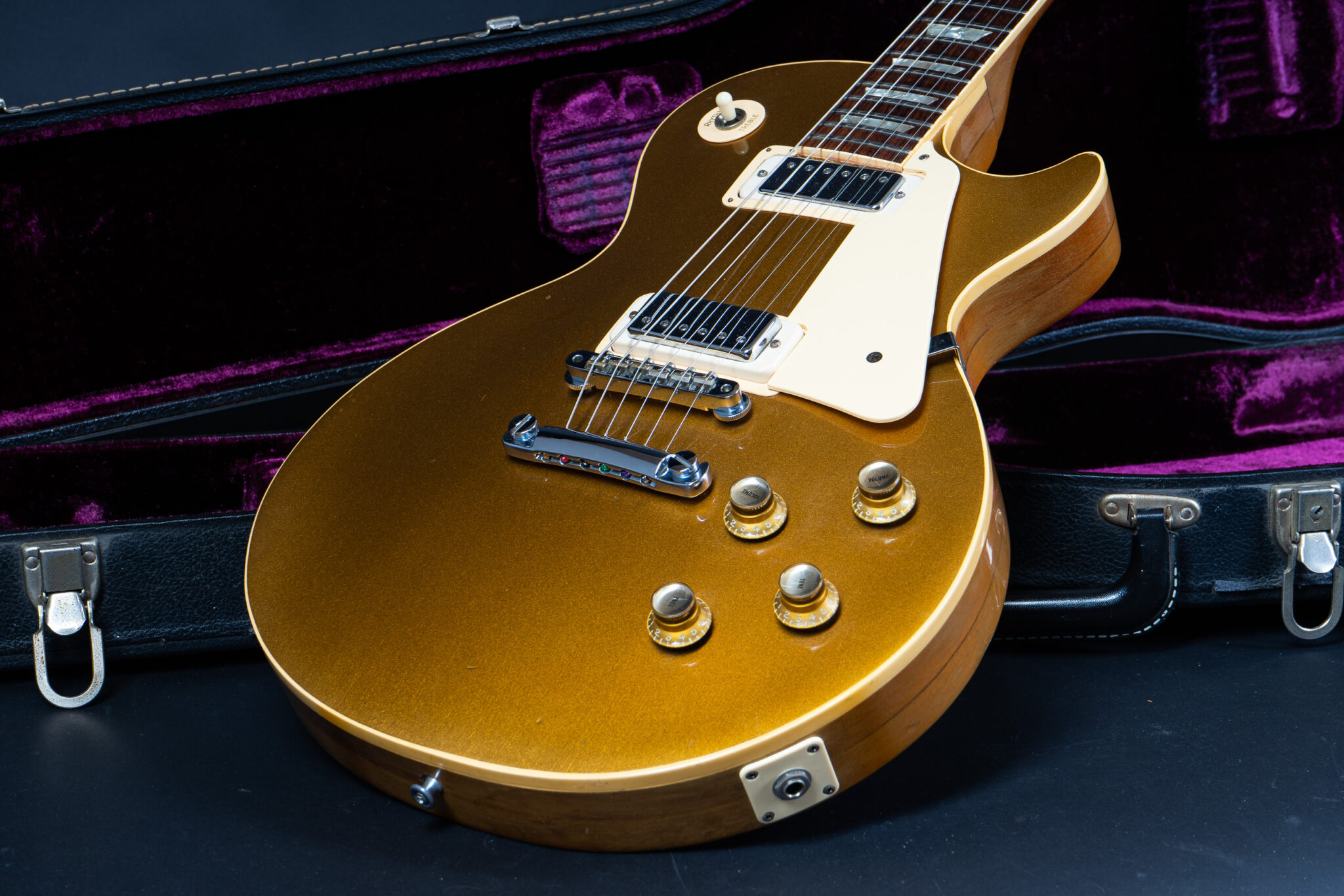
Fender was officially sold to CBS on January 1, 1965, although changes in production had already become apparent by mid to late 1964. From spring 1965 onward, Gibson shifted production almost entirely to a narrower nut width and, like Fender, replaced the Brazilian rosewood used until then with Indian rosewood. At Fender, the contours of the Stratocaster changed noticeably, the shapes became rougher, and efficiency began to take precedence over guitar craftsmanship. From 1968 onward, Fender also started using polyurethane finishes, especially on necks. In 1969, Gibson was sold to the Norlin Corporation, marking a similar shift from quality toward quantity and cost efficiency. Multi-piece bodies, less carved Les Paul tops, thicker lacquer.
Still Vintage,
Still Iconic
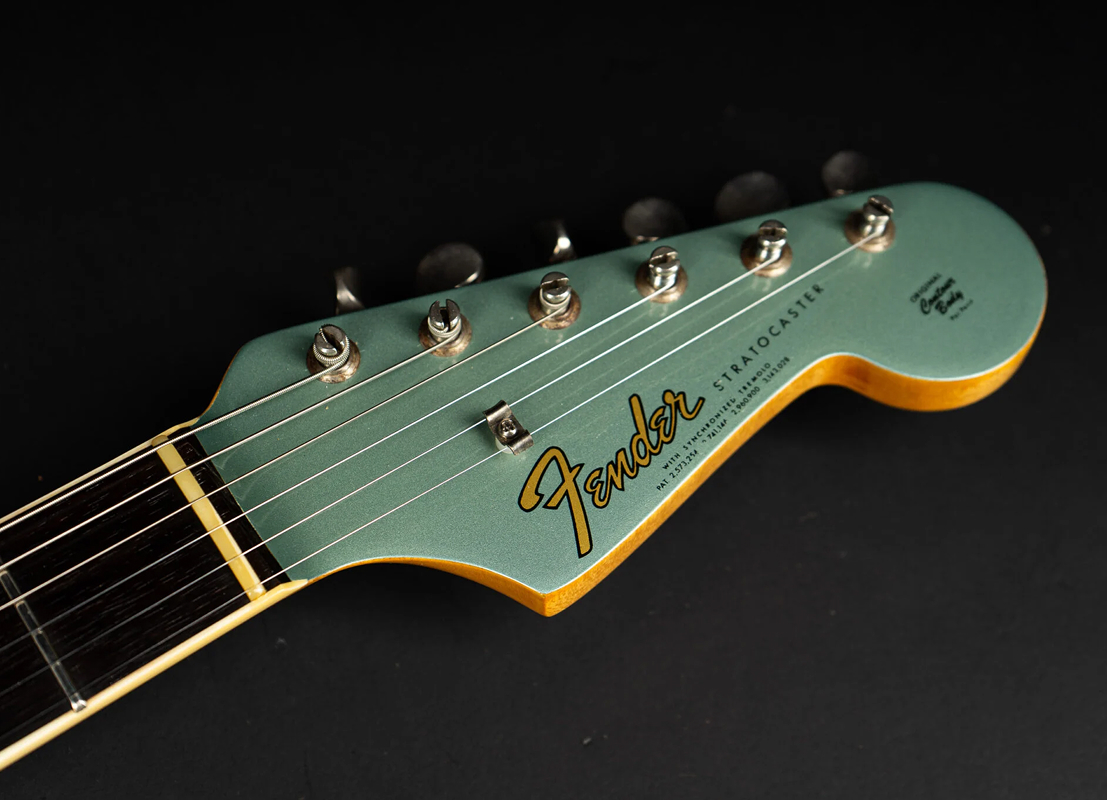
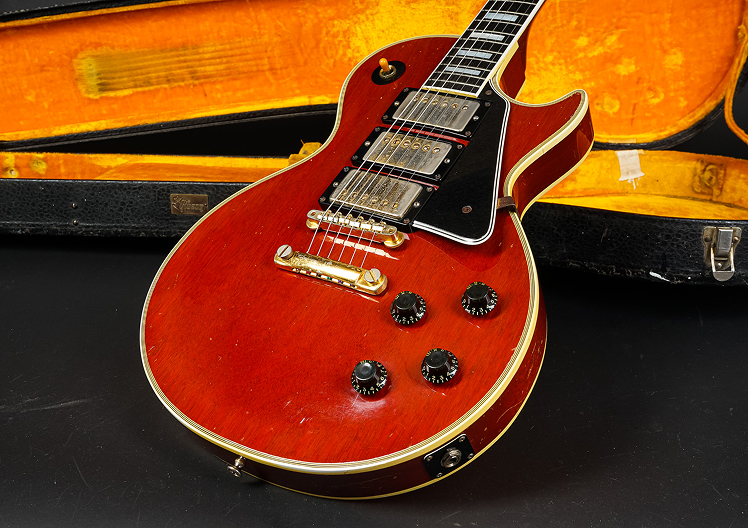
Nevertheless, many CBS- or Norlin-era guitars have become highly sought-after collector’s items, especially within the historical context of rock and blues music. For that reason, we would still consider the years 1965 to 1974 part of the vintage era. From 1975 onward, however, additional production changes to classic Fender and Gibson models caused the instruments to move noticeably further away from their original design. The Les Paul received a Nashville bridge and a three-piece maple neck, while the Strat lost its staggered pickups.
Beyond Labels:
Find Your Guitar
All of this ultimately comes down to nuance, and whether a guitar is classified as vintage or used is of secondary importance. What really matters is finding the right instrument for you, regardless of its year of manufacture. There are great and less inspiring examples from every year, and even that remains entirely subjective.
Instruments
with a Soul
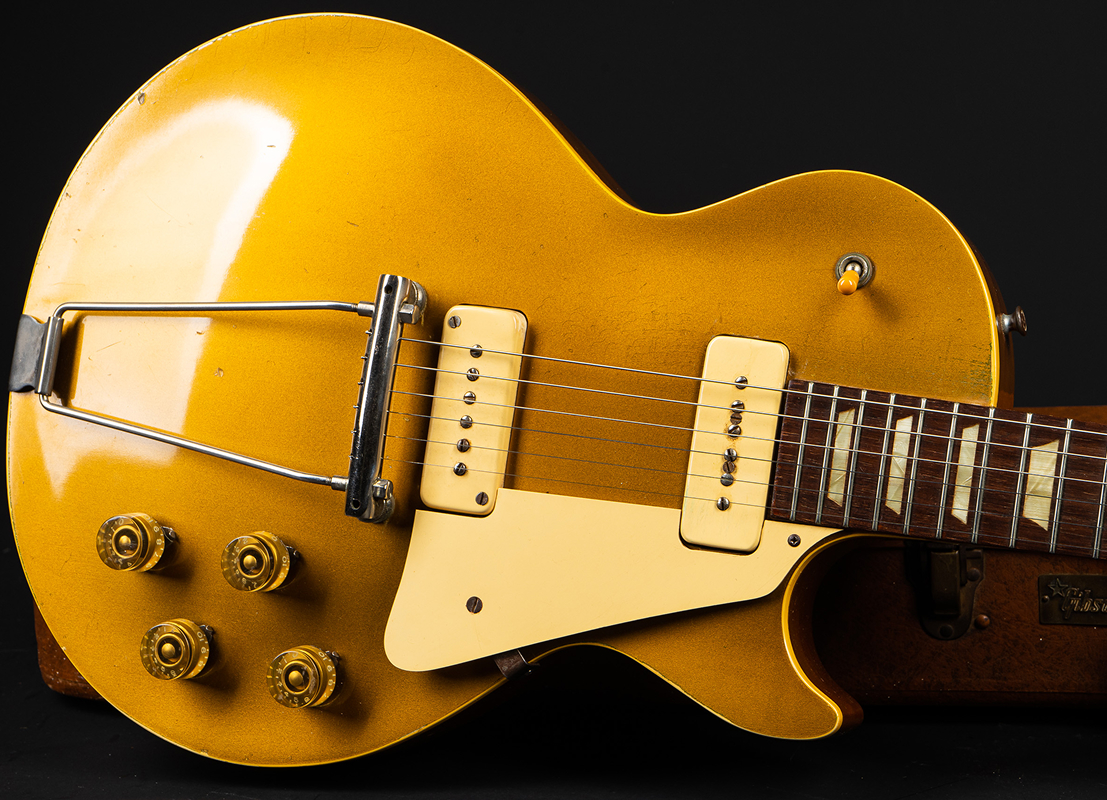
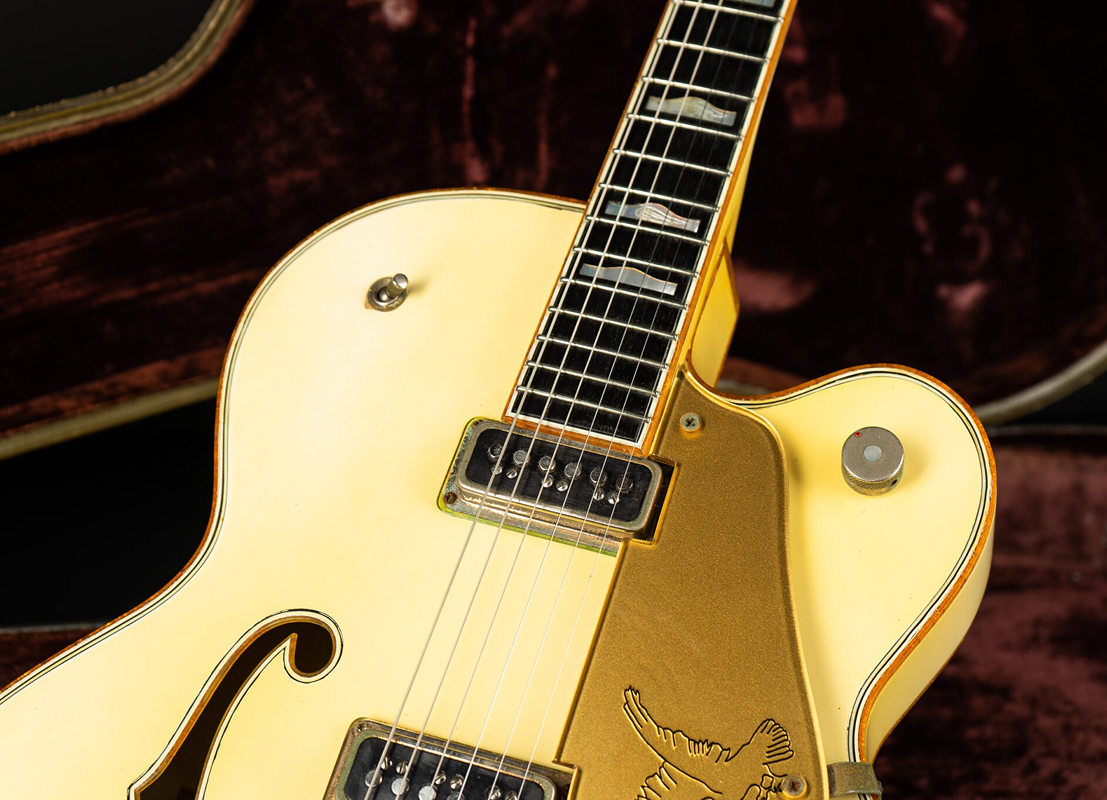
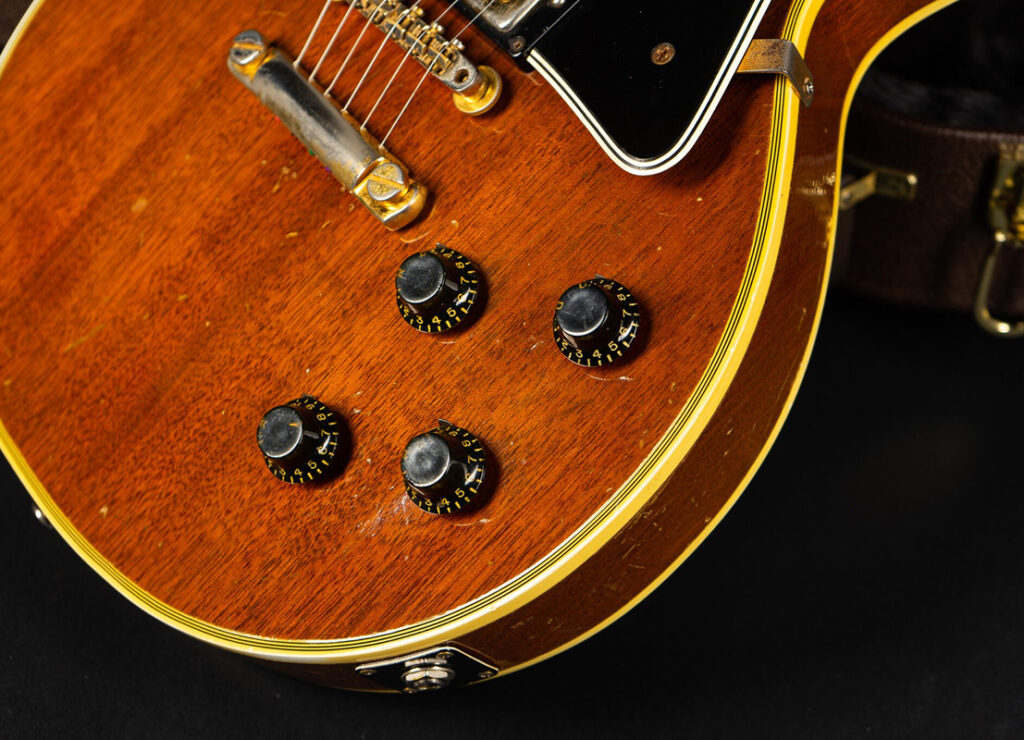
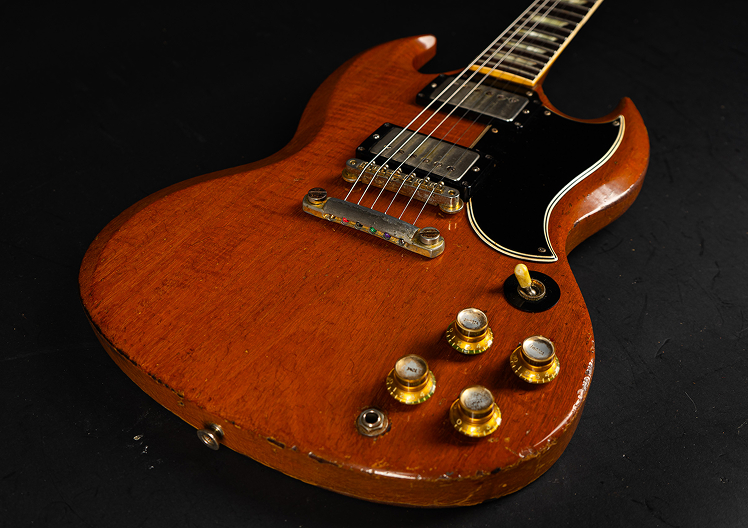
So why vintage guitars? Because they offer a truly special playing experience. Vintage guitars are witnesses to their time. Some were built before entire musical styles had even fully emerged, and in many cases they helped shape the sound and feel of what came after. Holding one in your hands means holding a piece of music history: a guitar identical to the one used to record a particular song, played at a legendary concert, or forever associated with a specific artist. It is this unique combination of sound, history, and emotion that makes vintage guitars so desirable.
The Guitar That
Plays You Back
Time and again, professional musicians who play a special vintage guitar at our store tell us how amazed they are by the way these instruments respond to their playing style — and by how much more easily they can express themselves musically through them. The responsiveness, frequency spectrum, and tonal development certainly play a role. But even here, subjective perception remains the deciding factor.
Investments
with A Personal Connection
Vintage guitars as an investment — we are often asked which models are particularly well suited as investments. The honest answer is that we cannot see into the future. During the Covid years in particular, the market exploded, and in some cases prices doubled. That was clearly an exceptional moment, and some prices have since normalized. Even so, the market remains stable, and certain guitars continue to appreciate in value.
As a general rule, the cleaner the guitar, the more complete the case candy and accessories, and the rarer the model, the better. Classic Fender and Gibson models such as the Les Paul, Stratocaster, Telecaster, ES-335, and Jazzmaster are usually stronger investment candidates than more unusual models. That said, a personal connection to the instrument is just as important — a reason for buying it that goes beyond pure investment. A guitar tied to your favorite artist, your year of birth, or another personal story will always offer more than financial value alone. In the end, you should enjoy your purchase.

Authenticating
a vintage guitar
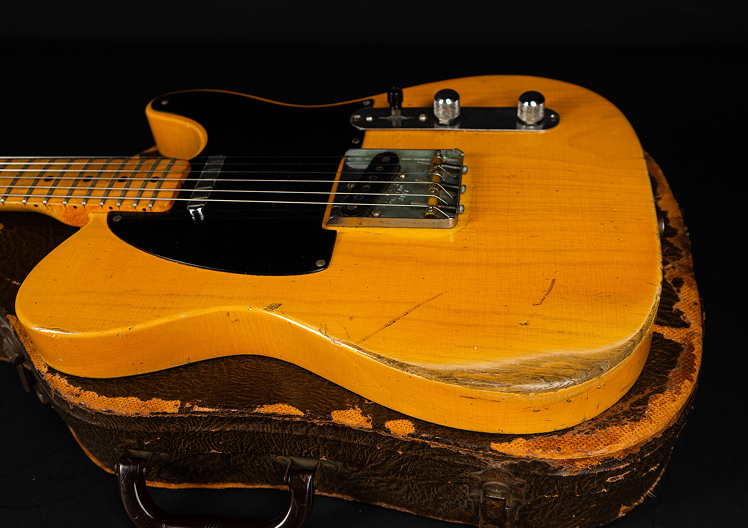
The supreme discipline. How often do we hear statements like: “My friend shone a UV lamp on it and said the finish was genuine,” or “The pickups sound so good, they must be original.” Unfortunately, it is not that simple. Verifying that a vintage guitar is truly original takes years of experience. And even that is only part of the story: many internationally respected experts still benefit from reputations built in a time before the internet, before high-resolution digital photography, before online databases, and especially before the kind of global exchange within the vintage scene that is possible today. Back then, instruments were simply not examined with the same intensity, values were much lower, and the responsibility carried by dealers was correspondingly smaller.
Achieving goals with
passion, technology,
and global networking
We are part of a new generation of dealers defined by greater depth, greater passion, and greater precision. We use every technical tool at our disposal and remain open to any new opportunity that helps us move closer to our goals. We are obsessed with detail, internationally well connected, and an integral part of the global vintage community. GuitarPoint enjoys a worldwide reputation for excellence, and we have handled some of the most exclusive instruments in the world. We never rest on our laurels — we keep learning every single day.
Every detail
counts
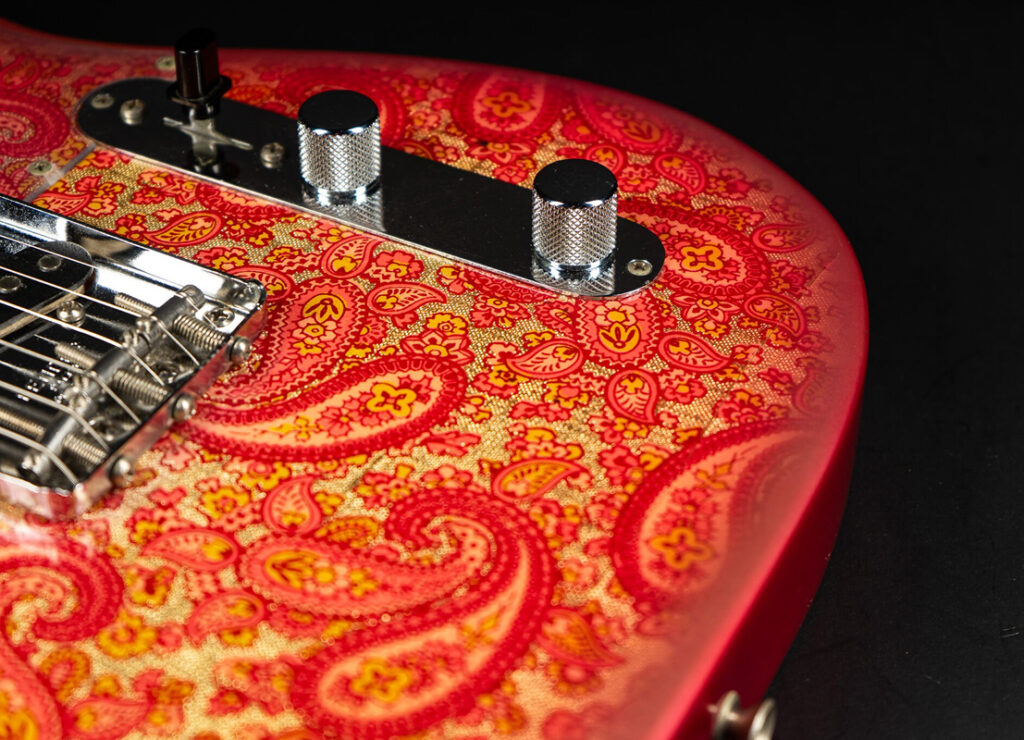
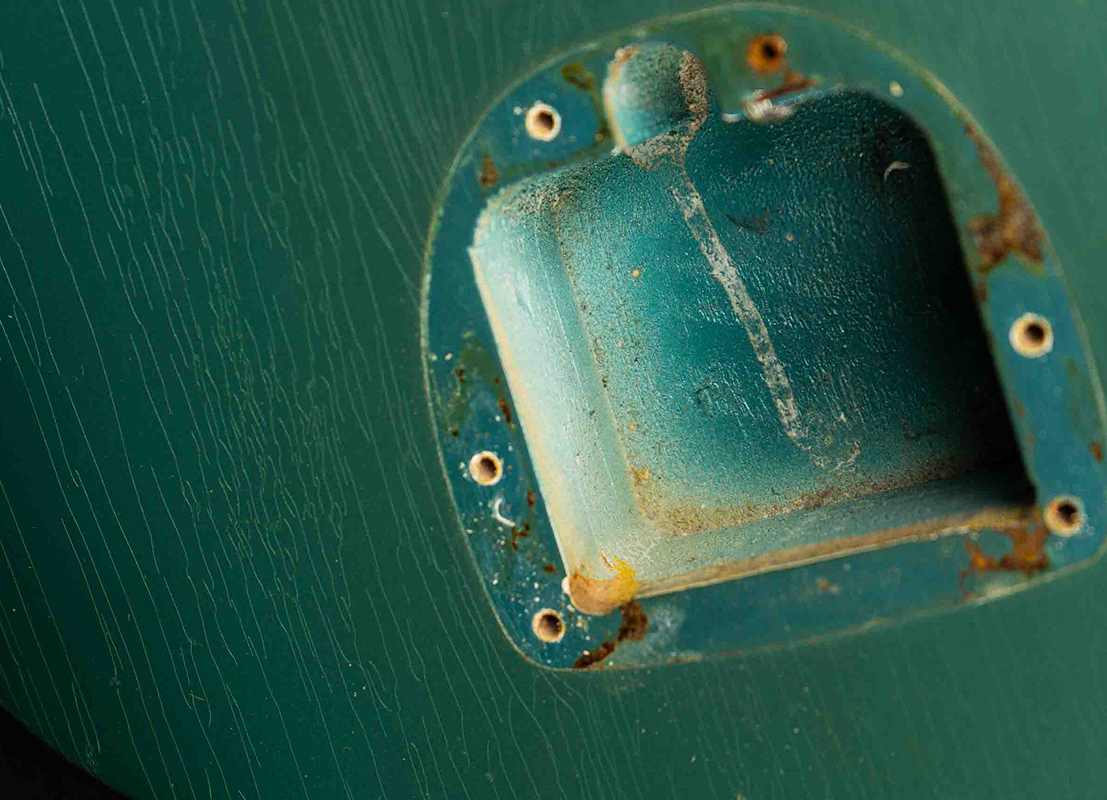
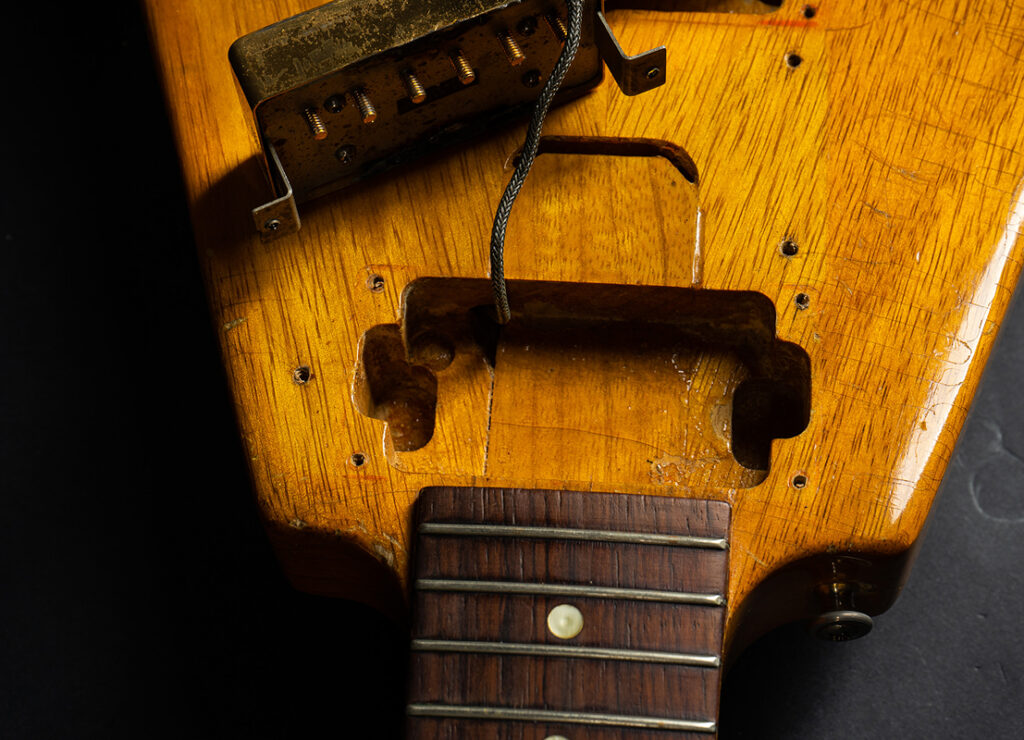
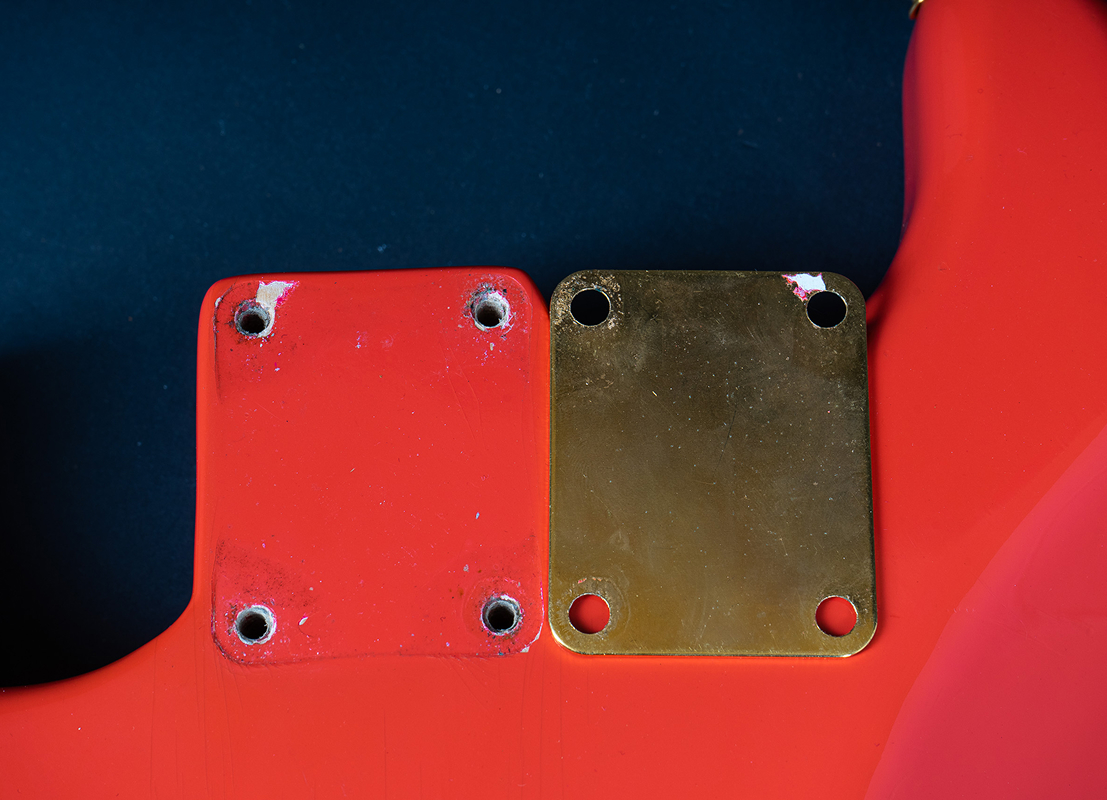
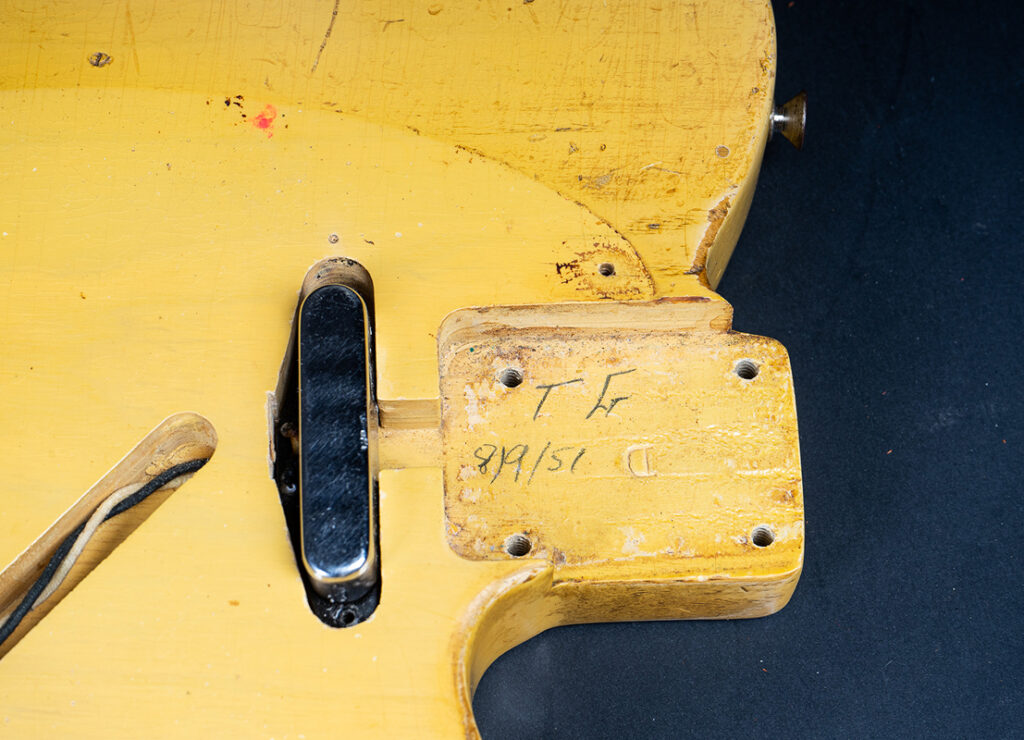
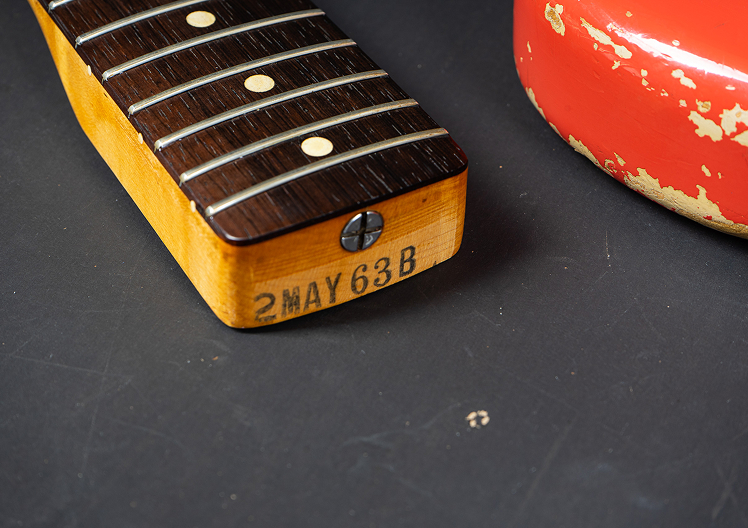
The authentication process can take anywhere from a few minutes to several days, depending on the model and finish. Each model has certain key areas we examine first in order to rule out counterfeits. In the case of Fender guitars especially, countless fakes are in circulation — either entirely new instruments assembled with some old original parts, or guitars that have been refinished in a “custom color” to increase their value and are then presented as original. That is why buying from a reputable dealer is so important. For a layperson, it is almost impossible to detect a well-made counterfeit instrument for what it really is.
transparency
is a must
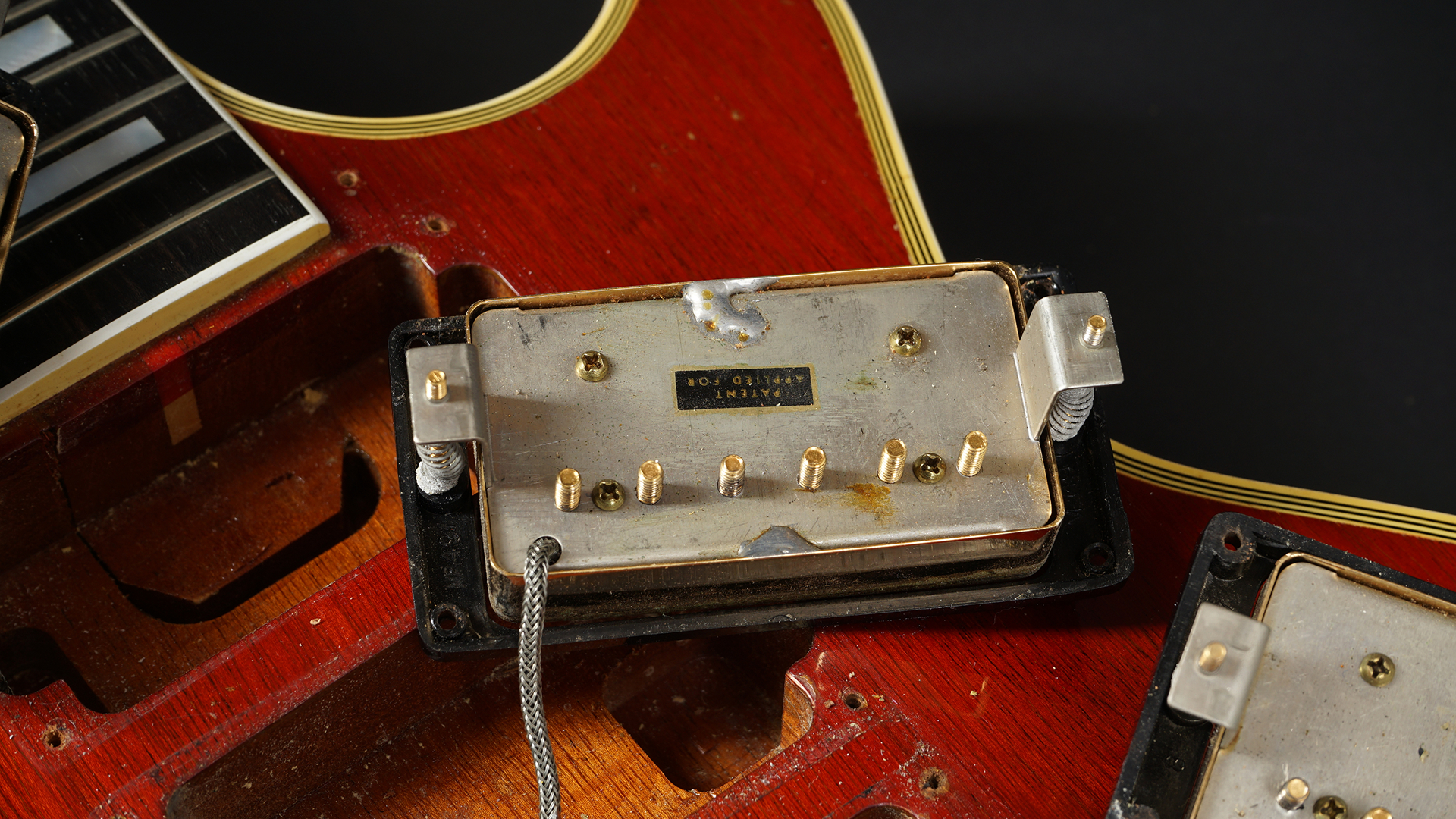
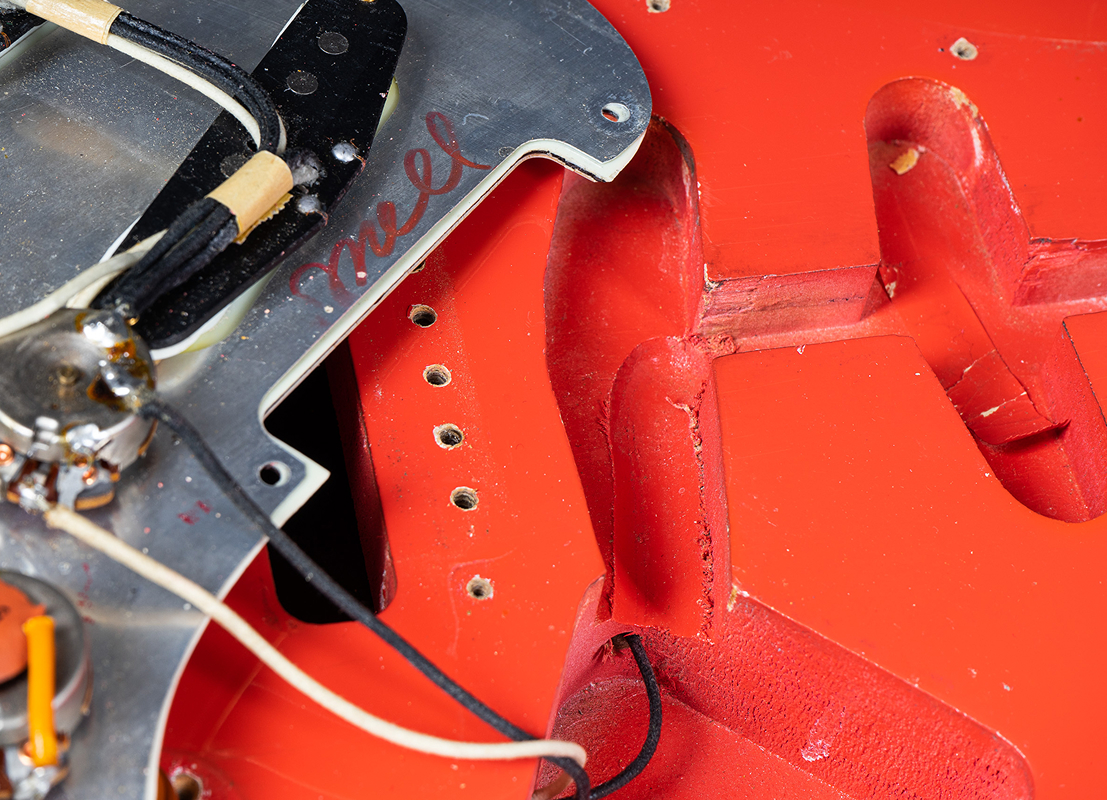
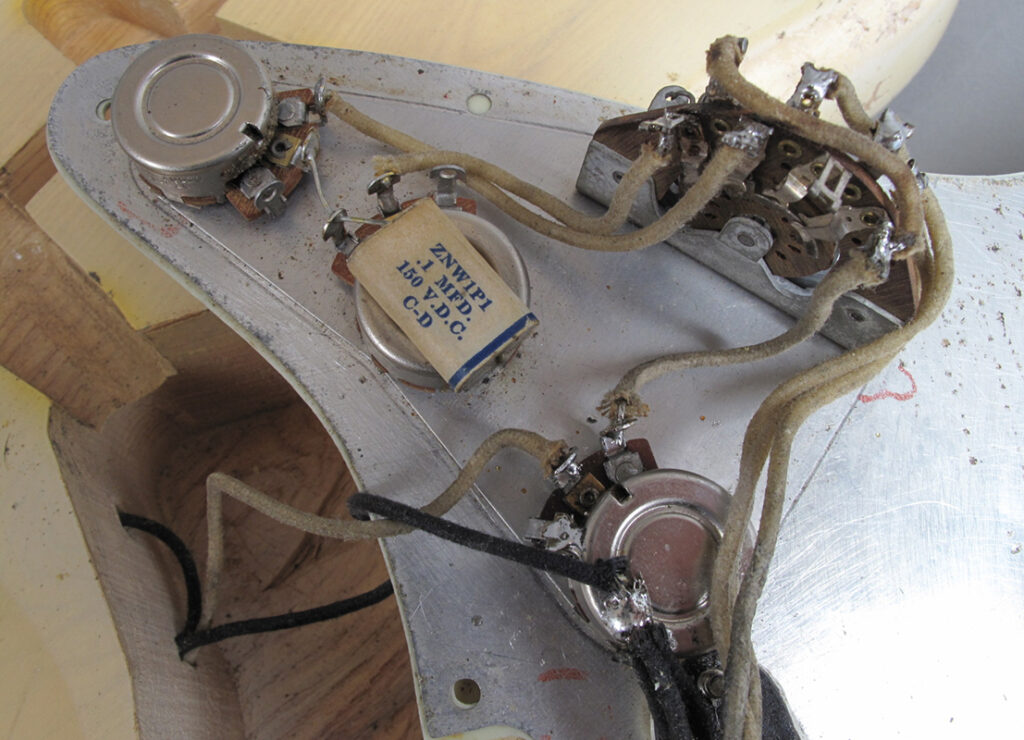
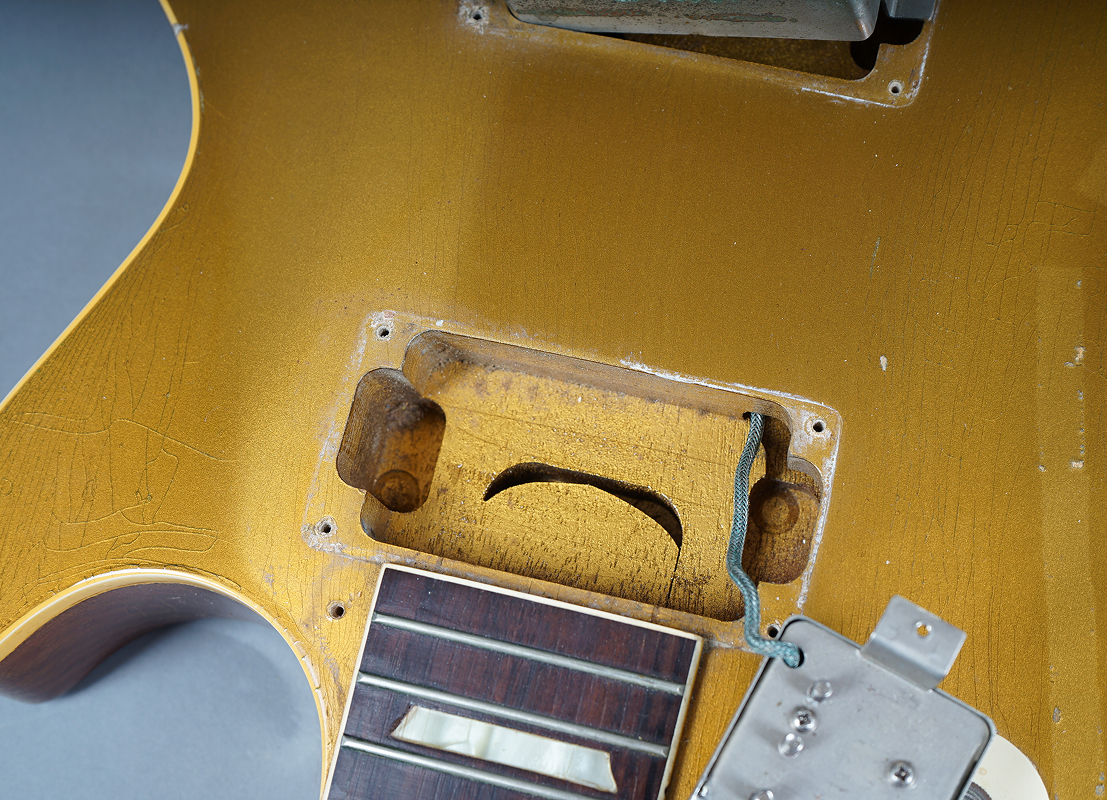
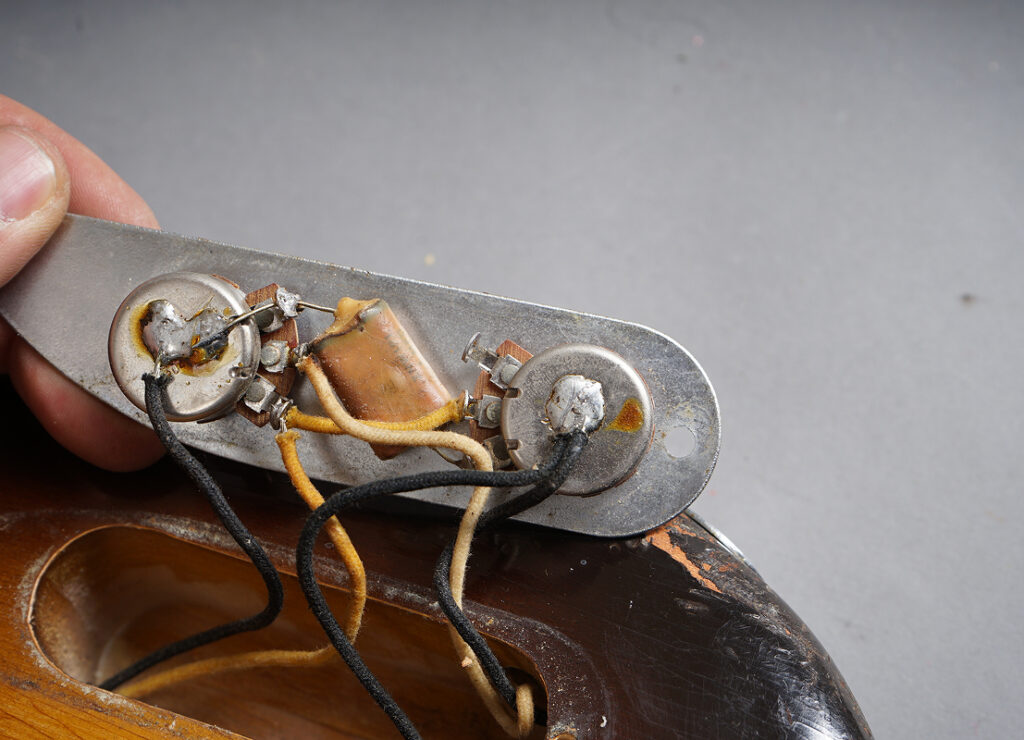
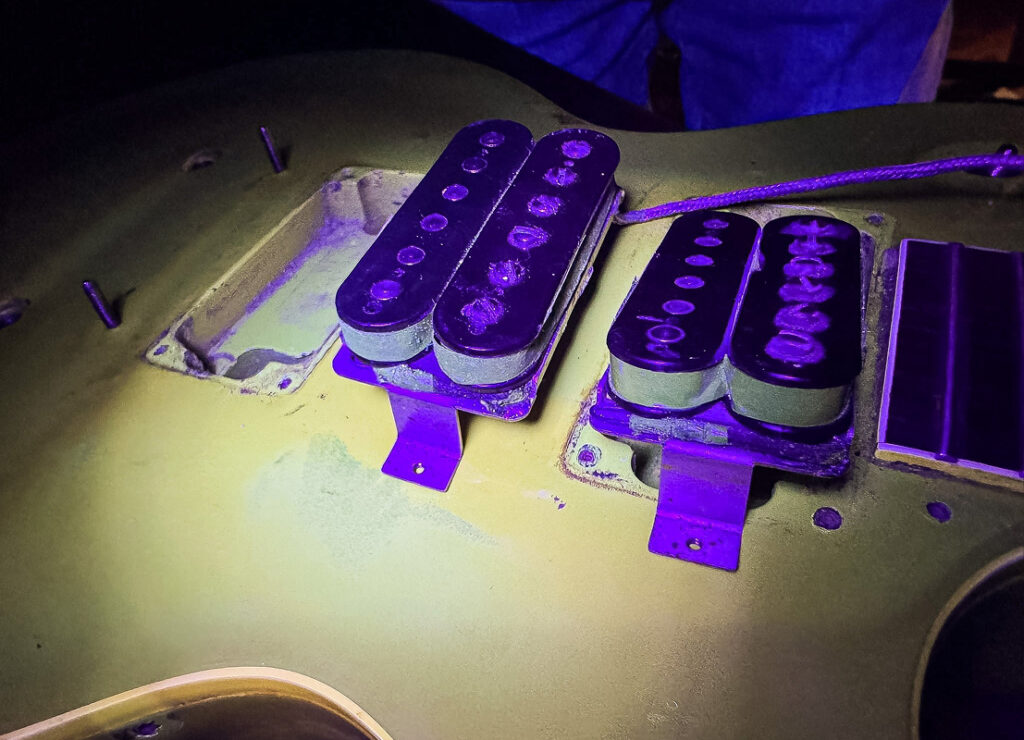
In addition to outright counterfeits, there are of course also instruments that have been modified over time. In many cases, that happened for practical reasons — after all, these guitars were used as what they were meant to be: musical instruments. Fender pickups, for example, are extremely fragile, with coil wires thinner than a human hair, and they were never designed to last forever. Five-way switches are more practical than three-way switches, and a stop tailpiece on a ’60s ES-335 may sound better than a trapeze tailpiece. Some modifications remain in place and are sold transparently as honest player mods. Far too often, however, such details are concealed — either because no one looked closely enough or because the work was not done properly. If a humbucker cover has been desoldered, we desolder it again to see what is underneath. For us, that is mandatory. We stand behind that standard. Every modification is disclosed and reflected in the price.
Why black light
alone doesn’t provide answers
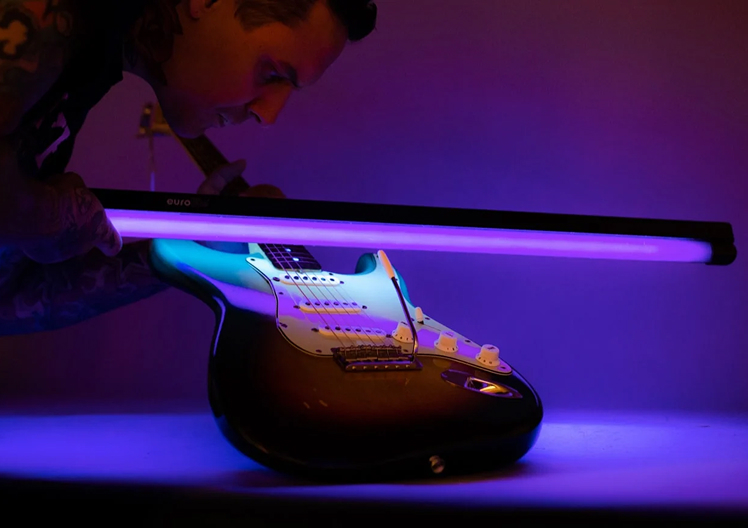
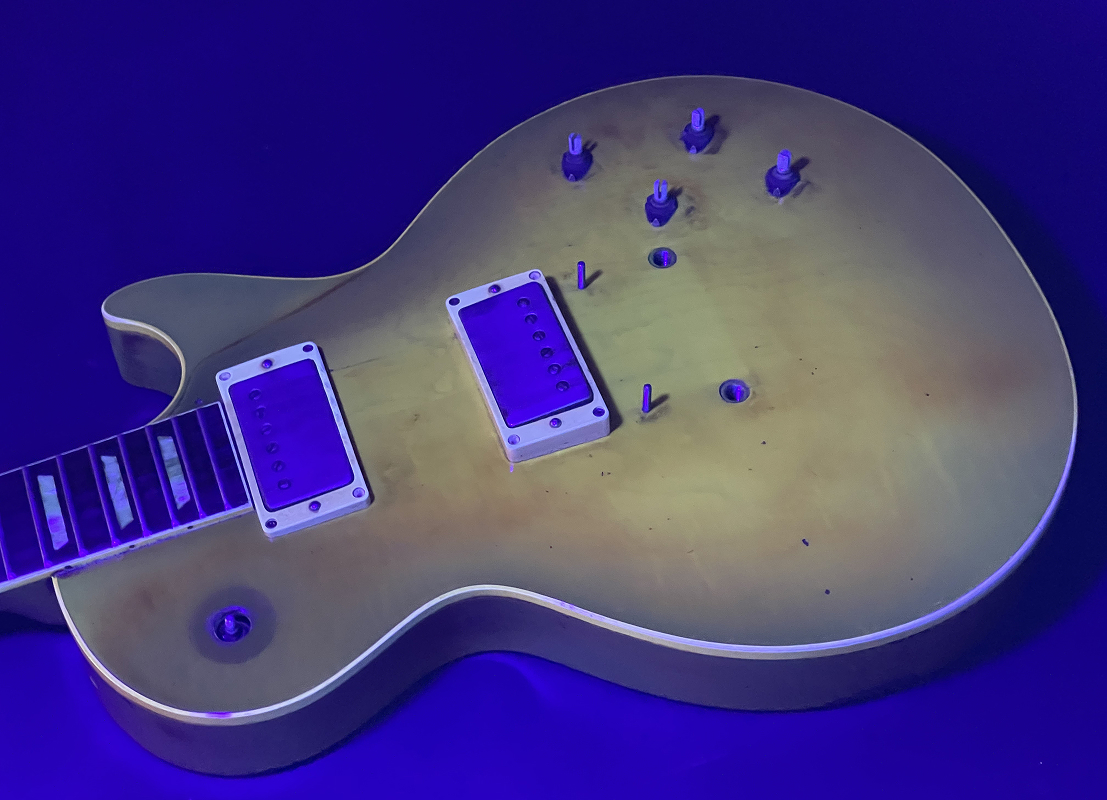
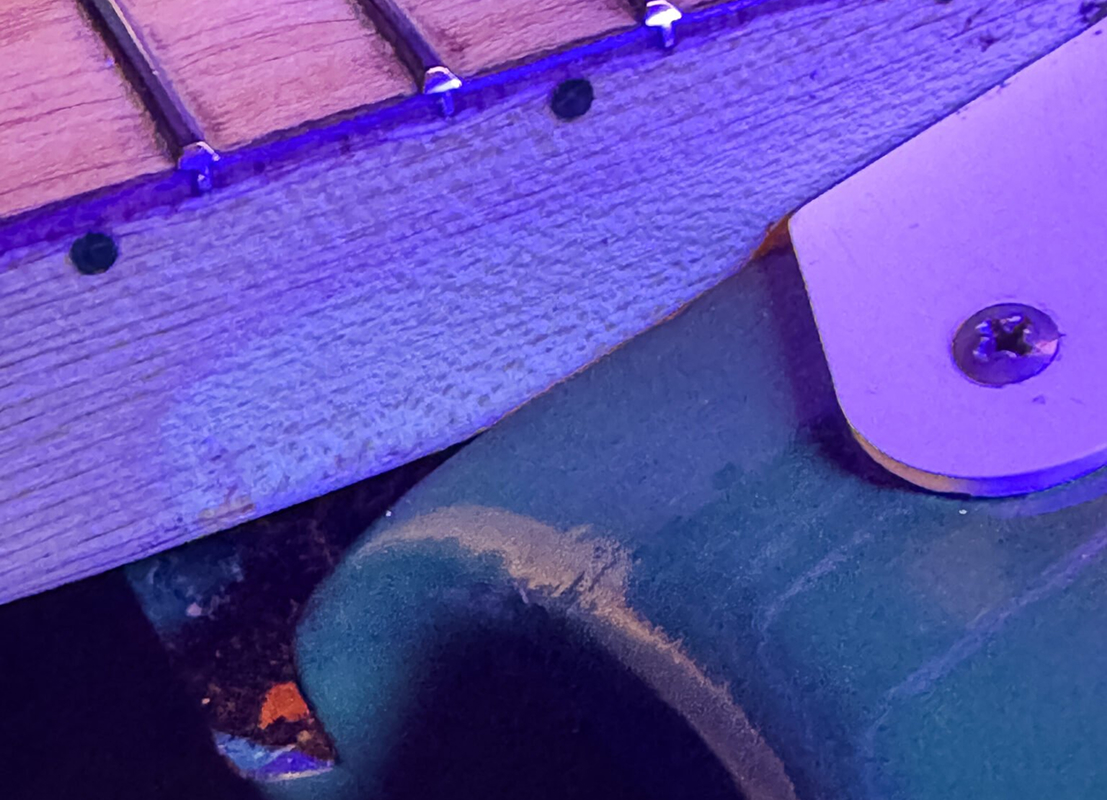
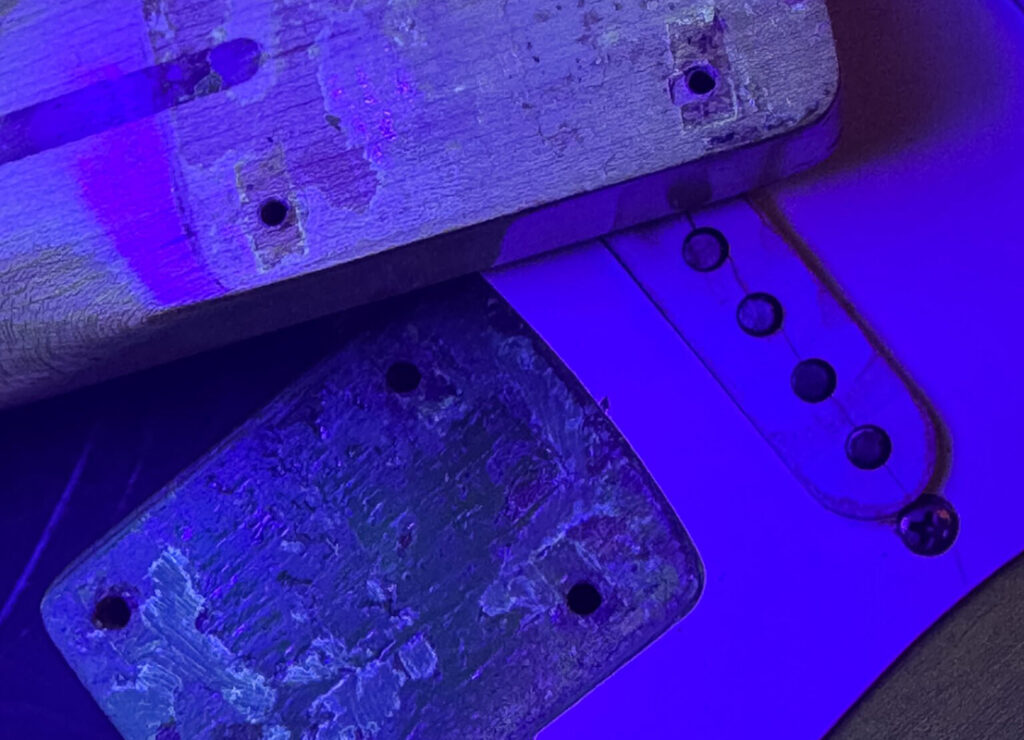
On the subject of black light or UV light: it may be the most important unimportant thing of all. If you do not know exactly what you are looking for, it is completely useless. It glows green, so the finish is original? “Well, it blacklights right …” We hear that even from reputable dealers. It is complete nonsense. The finish on vintage guitars glows green under UV light because, over time, the breakdown of certain components creates so-called fluorophores.
The clear coat in particular often glows greenish under UV light. However, that does not automatically mean the finish is original. In fact, it is entirely possible — and often the rule rather than the exception — for a guitar refinished in the 1960s, 1970s, or even 1980s to glow green as well, especially if a similar nitrocellulose lacquer was used. A UV test therefore tells you very little on its own about the originality of a finish. What really matters are inconsistencies, differences in color transition, repairs that are difficult to spot with the naked eye, or structural work carried out on the wood itself.
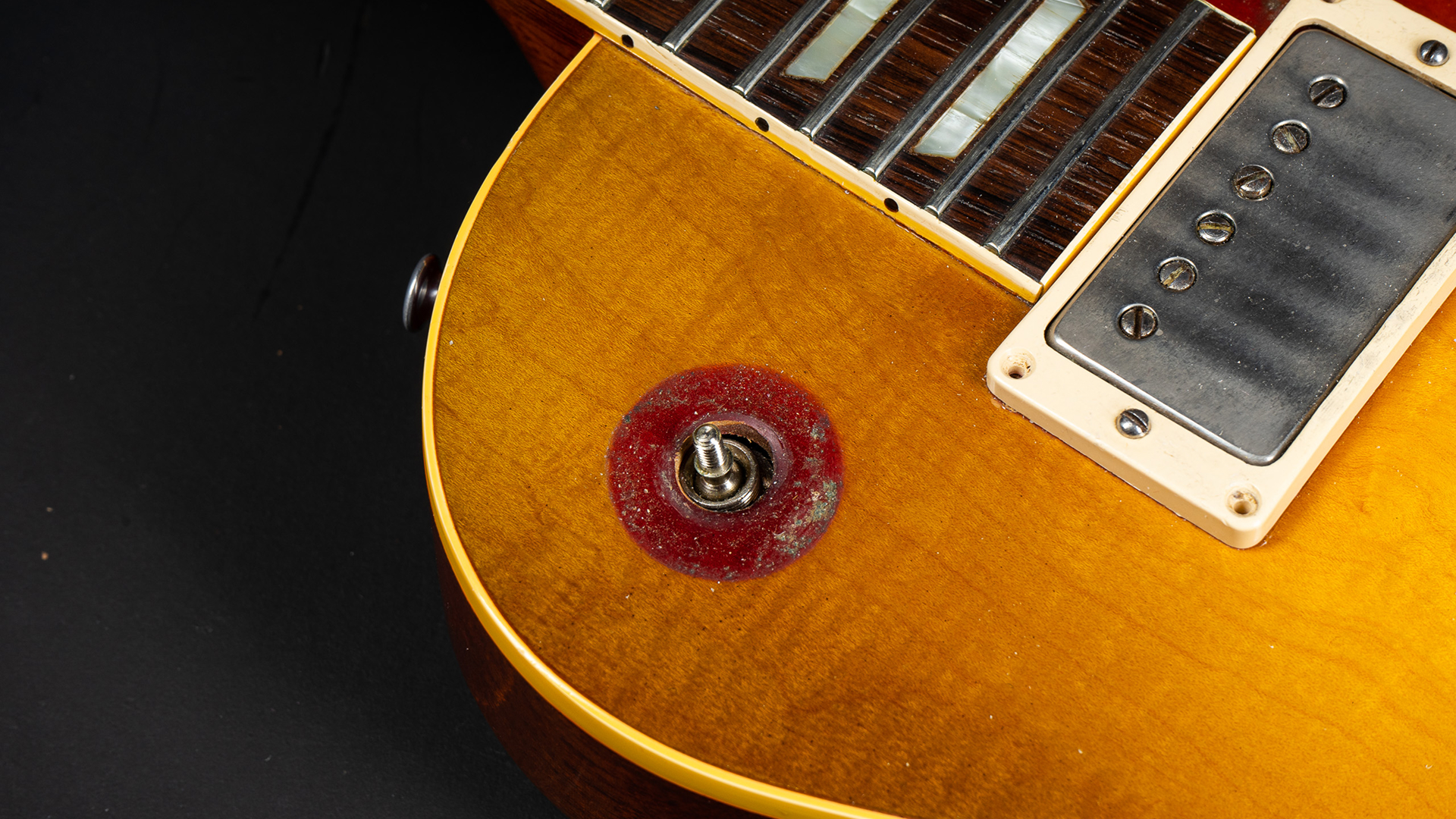
UV light becomes much more valuable when, for example, verifying whether a Fender neck truly belongs to the body or whether plastic parts are original. But even then, knowing exactly what to look for is essential. A UV test is part of every serious assessment — but only as a tool, never as proof on its own. Often, far more telling is something like the smell of the finish. Depending on the maker and the year, a guitar can have a very specific smell that simply cannot be faked. The texture of the finish, the condition of the lacquer in the cavities, the type of weather checking, fading, and many other details can also help us assess authenticity.
The next level –
we authenticate with scientific material analysis
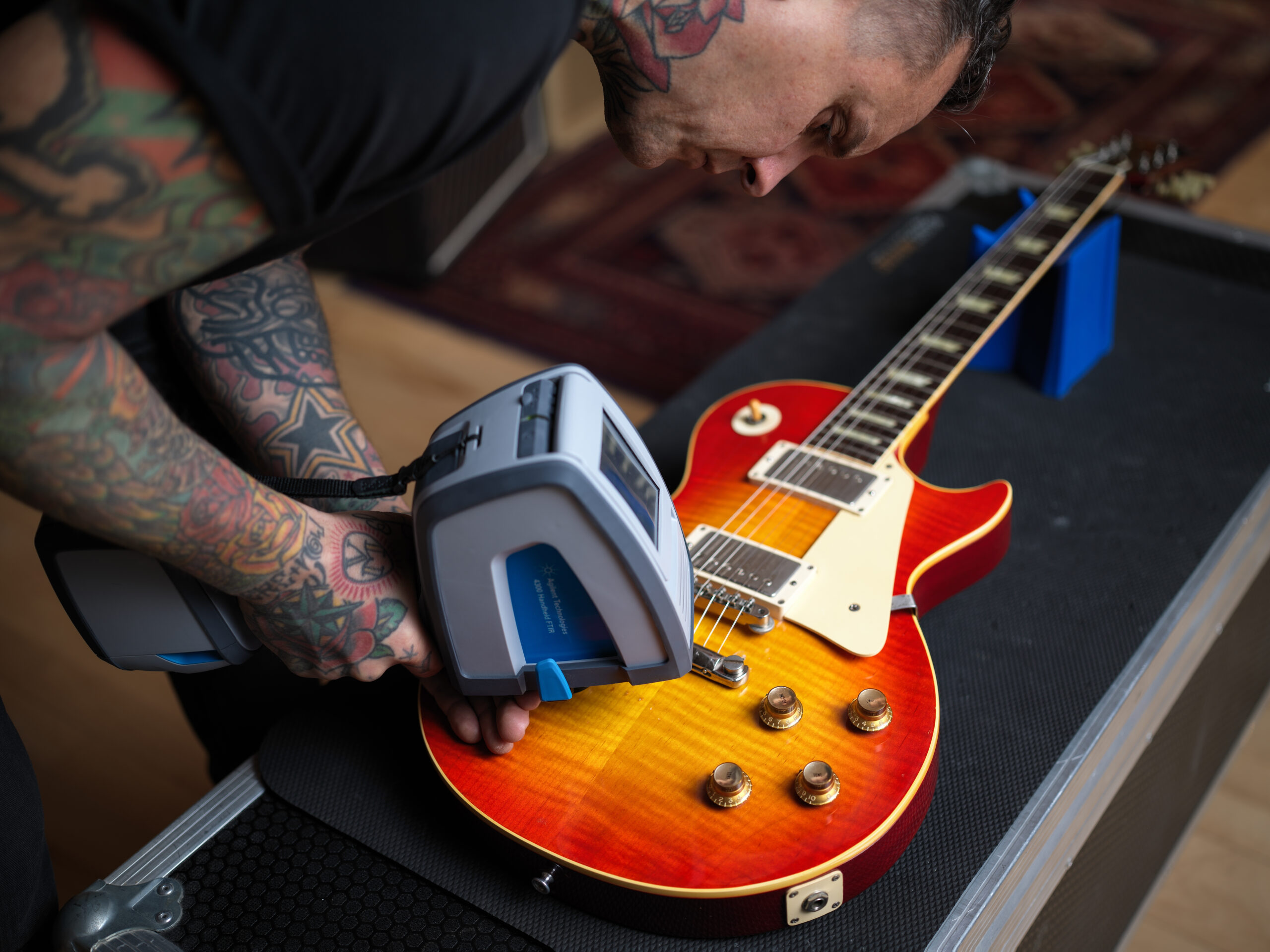
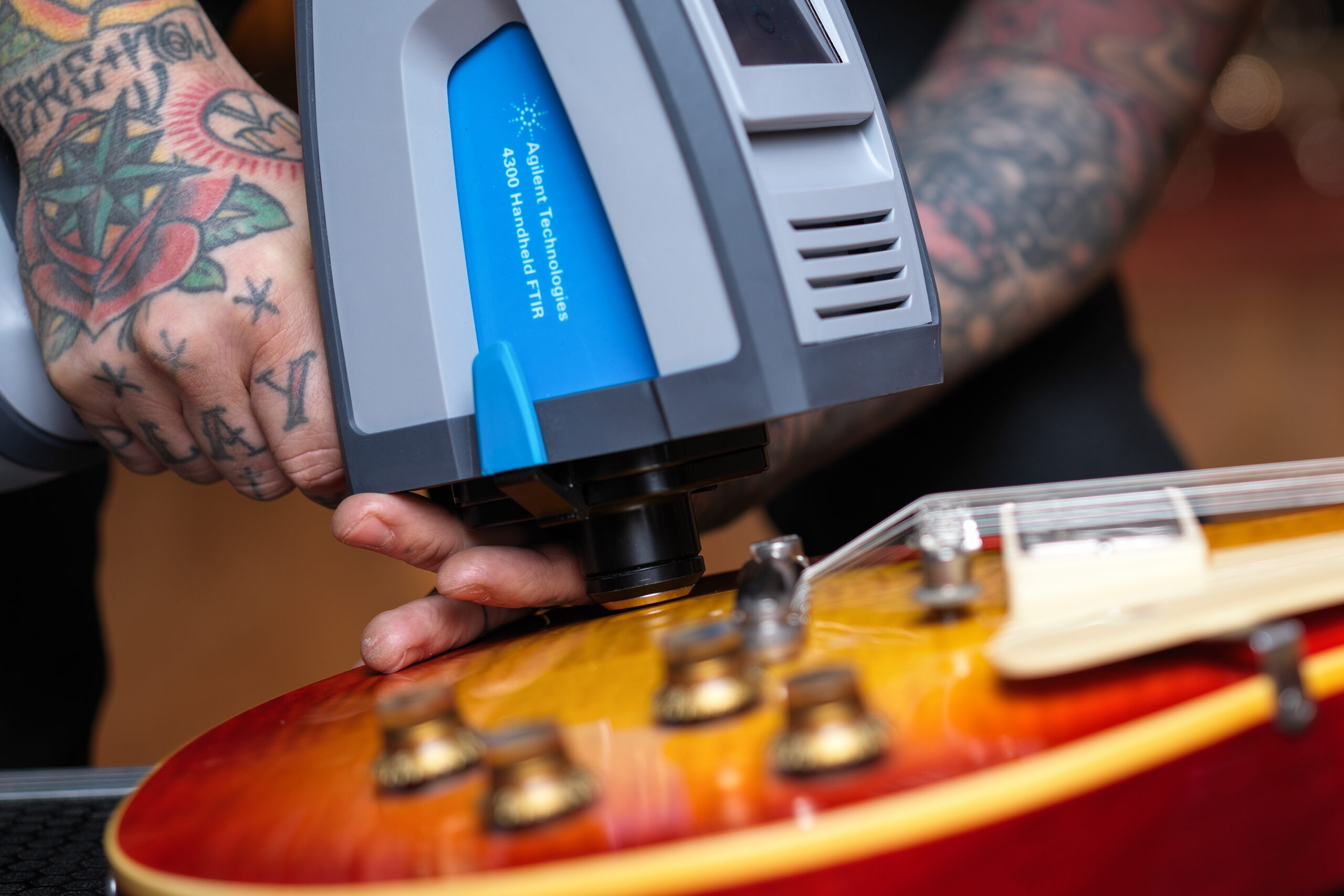
When it comes to vintage finishes, some details may look visually convincing but remain difficult to classify reliably without additional data. That is why we use FTIR spectroscopy to analyze the chemistry of a finish directly on the instrument in a non-destructive way — without removing paint chips, as some chemical testing methods require. The result is a characteristic material signature of the finish, which we compare with reference data. The foundation of this approach is our extensive reference database, containing measurement data from hundreds of instruments. Because this database continues to grow every day, a single measurement becomes far more than just an isolated spectrum. Each spectrum contains distinctive “fingerprints” that can be clearly linked to specific manufacturers and periods.
FTIR is therefore a central part of our process, as it provides objective and reproducible measurement data that adds another layer of support to our assessment. At the same time, FTIR does not constitute a complete authentication of an instrument on its own. Its value depends on correct measurement, expert interpretation, and careful integration into the overall findings. That is exactly how we use it: as a measurement-based complement to our traditional analysis, with a particular focus on the finish itself.
Technically, FTIR is based on measuring infrared absorption. The resulting spectrum displays characteristic bands that allow conclusions to be drawn about finish and binder systems. This is especially valuable when evaluating period-correct finish systems or when interventions such as overspray, local touch-ups, or complete refinishing are suspected. What matters is never a single signal in isolation, but the overall profile when compared with reliable reference data.
Depending on the question at hand, we use different FTIR measurement geometries. The effective sampling depth depends on the measurement objective, the material, the measurement geometry, and the surface properties. For that reason, we follow clearly defined procedures and interpret every measurement within its specific context.
FTIR is a well-established method in material analysis and has been used for decades to study historical finishes and binders in restoration, including in art conservation. At the same time, our overall assessment remains intentionally holistic: we combine FTIR with dating, specification checks, hardware and electronics inspection, serial number and production-feature analysis, as well as detailed visual examination and historical context. For specialized questions and methodological cross-checks, we also work closely with a laboratory specializing in finishes. The result is an assessment that is technically sound, transparently documented, and appropriate to the instrument.
Get in
Touch